
Get Quotation
Call Support
+62 298 322900
Work Hour
Mon - Fri 08:00 - 17:00
NEWS & BLOG
Fiber Cement vs Plywood & Gypsum: The Best Material Comparison for Your Home
Choosing the right building material is a pivotal decision that impacts a project’s cost, longevity, and safety. For many homeowners and contractors, the primary choices for walls, ceilings, and partitions often come down to three popular options: fiber cement board, plywood, and gypsum board.
Each material has its unique set of advantages and disadvantages. This comprehensive guide will provide a detailed, side-by-side comparison to help you make an informed decision and build a home that is both beautiful and resilient.
1. Understanding the Materials: A Quick Overview
Before diving into the direct comparison, it’s essential to understand what each of these materials is made of and their typical uses.
Fiber Cement Board
Fiber cement board is a composite material made from a mixture of cement, finely ground sand, cellulose fibers, and water. The mixture is pressed into dense, flat sheets that are remarkably strong and versatile.Modern fiber cement boards are engineered to be 100% asbestos-free, making them a safe and non-toxic building solution.
Plywood (Triplek)
Plywood is a traditional building material made by gluing together thin layers (veneers) of wood. Its crisscross grain pattern gives it strength, and it is a popular choice for furniture, flooring underlayment, and some non-structural applications. It is widely available and often used for temporary formwork in concrete construction.
Gypsum Board
Gypsum board, also known as drywall or sheetrock, is primarily made of gypsum plaster pressed between two sheets of paper.It is a common material for interior walls and ceilings due to its lightweight nature and smooth surface, which is ideal for painting and finishing.
2. Head-to-Head Comparison: Fiber Cement Board vs. The Rest
This is where the real differences become clear. When evaluating these materials, it’s important to look beyond the initial cost and consider factors that will affect the building’s performance and maintenance over its entire lifespan.
Durability & Longevity
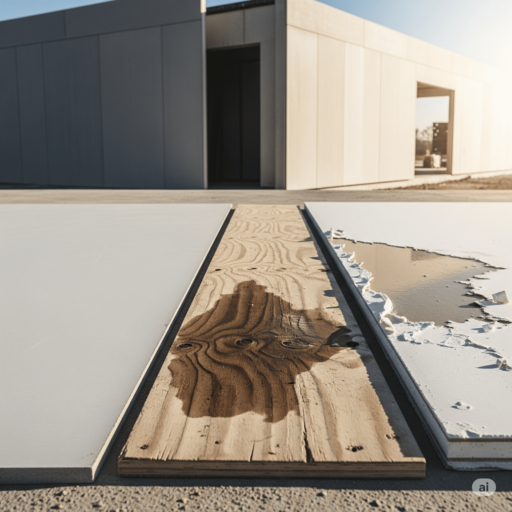
- Fiber Cement Board:This material is built to last. It is known for its exceptional durability and dimensional stability, meaning it won’t warp, crack, or twist under normal conditions.It is resistant to extreme weather, moisture, and UV rays, giving it a service life of up to 50 years or more with proper installation.
- Plywood : While strong and flexible, plywood is not designed for long-term exposure to the elements. It is highly susceptible to water damage, rot, and decay, which can cause it to swell, warp, and crumble over time.
- Gypsum Board :Gypsum is brittle and fragile. It is prone to damage from impacts and is not at all water-resistant. Even minor water exposure can cause it to disintegrate and lose its structural integrity.
Winner: Fiber Cement Board
Fire and Water Resistance
Safety is a primary concern in any construction project. The fire and water resistance of a material can be a life-saving feature.
- Fiber Cement Board :This material is inherently non-combustible. It will not ignite when exposed to direct flames and does not contribute fuel to a fire, often earning a Class A fire rating. It also has excellent resistance to moisture and is suitable for high-humidity areas like bathrooms and kitchens.
- Plywood: Plywood is a wood-based product and is therefore highly flammable. While some versions are treated to be more fire-resistant, they do not match the non-combustible properties of fiber cement. Plywood is also not water-resistant, with waterproof versions only offering limited protection.
- Gypsum Board : While gypsum board has some fire-resistant properties, it is not fireproof in the same way as fiber cement. Its paper surface can be flammable, and prolonged exposure to heat or flame will eventually break it down. It is also not water-resistant and will quickly degrade when wet, making it unsuitable for areas with high moisture or for external use.
Winner: Fiber Cement Board
Pest and Termite Resistance
In tropical climates like Indonesia, termites can cause significant and expensive damage to homes. Choosing a material that is naturally resistant to these pests can save you a great deal of money and worry in the long run.- Fiber Cement Board: One of the most significant benefits of fiber cement board is that it is completely unappealing to termites and other wood-boring pests. Since it contains no wood, it provides a protective barrier against infestation.
- Plywood: As a wood-based product, plywood is a prime target for termites and other insects. A termite infestation can quickly compromise the structural integrity of a building that relies on wood materials.
- Gypsum Board: While termites are not typically attracted to gypsum itself, they can tunnel through the paper backing and cause damage. In humid environments, the presence of moisture in the board can attract pests.
Winner: Fiber Cement Board
Cost and Long-Term Value
The initial price of a material does not always reflect its true value over time.- Plywood: Generally, plywood is the most affordable option upfront. However, its short lifespan and vulnerability to pests and decay mean it will likely need to be replaced and repaired sooner, leading to higher long-term costs.
- Gypsum Board: Gypsum is also a cost-effective choice for interior applications. Its main drawback is its lack of durability, which can lead to frequent repairs, especially in high-traffic areas or where there is a risk of moisture.
- Fiber Cement Board: Fiber cement board may have a higher initial cost than plywood or gypsum, but it offers a much better return on investment. Its durability, resistance to fire and pests, and low-maintenance properties mean it will not need to be replaced or repaired for decades, saving you a significant amount of money and effort in the long run.
3. Ideal Applications for Each Material
The best material for your project depends on its specific requirements and location.- Choose Fiber Cement Board when you need:
- Exterior cladding and siding that must withstand harsh weather.
- Durable fencing, fascia, and decorative elements that won’t rot or attract termites.
- A ceiling or partition wall in high-moisture areas like kitchens, bathrooms, or outdoors.
- A high-performance, fire-resistant material for added safety.
- A long-lasting, low-maintenance solution that increases a property’s value.
- Choose Plywood when you need:
- Temporary construction purposes, such as concrete formwork or site hoarding.
- Interior furniture, cabinetry, or non-load-bearing wall panels where aesthetics and ease of work are prioritized over durability and resistance to moisture.
- Choose Gypsum Board when you need:
- A simple, smooth, and lightweight solution for interior walls and ceilings in dry areas
- An affordable material for interior renovations that are not in contact with water or heat.
4. Conclusion: The Smart Choice for Modern Construction
While plywood and gypsum board remain accessible and affordable options for certain projects, fiber cement board emerges as the clear winner in a head-to-head comparison on durability, safety, and long-term value. For any homeowner or contractor looking to build a stronger, safer, and more resilient structure, investing in high-quality fiber cement board is not just a material choice—it’s a strategic decision that pays off for decades to come.
Share this article :
Don't hesitate to contact us any time

Read our articles :
Fiber Cement vs Plywood & Gypsum: The Best Material Comparison for Your Home
The Ultimate Guide to Fiber Cement Board: Your Blueprint for a Stronger, Safer Home
Fire Ratings of Building Boards: Silica vs Fiber Cement
What Is Fiber Cement? Composition, Benefits, and Uses
Is Fiber Cement Safe for Health and the Environment?
©2025 nataliedju.com. for Tripilar Betonmas – All rights reserved.
 English
  Indonesian